Friday, May 16, 2014

Dr George John - World renowned Sports Surgeon

Photo courtesy : Melton Antony
published in The New Indian Express on May 13, 2014

I can show you 100 better players than Roger Federer. But it might not be easy for them to beat him. Because he plays with his mind, says Dr George John.

 Dr George John can talk at length not only about Federer, but also on many other top-seeded stars like Rafael Nadal, Novak Djokovic, Cristiano Ronaldo and even Diego Maradona. Years have gone by since this sports surgeon has been attending to their bruises and sprains. In a span of few years, this Orthopedic and sports surgeon, hailing from Punalur, became one of the most sought after surgeons by world renowned sports persons across the world.

A keen observer of sports, Dr George John is certainly not happy with the way sports are developing in the country. “Why are we missing out on several Sachins and Dhonis in tennis and badminton? Why is a boy who loves to play rugby or badminton taken so lightly?” he asks.

George John sadly points out that even now many sports organisations feel that it is unnecessary to hire a sports medicine expert as they already have physiotherapists.

Hence in an attempt to bring about a change in this scenario, George John is all set to share the experience he gained in the field of sports medicine. And as a first attempt on these lines he will soon start a full-fledged centre for Minimal Invasive Surgery in Kochi, which will be the first-of-its-kind in the country.

“It will become a reality in a matter of three years,” he adds. But to bring a whole new culture to the land, he is not ready to beseech the help of the government or any other sports organisations for that matter. “I have acquired a lot and it is now my turn to give it back to my motherland which I will do with my own resources,” he says. 

George John says that even the psyche of the people towards sports is blatantly disillusioning. “In our country, it is just the performance of a sports person that really matters. But in Western countries they go for both the individuals and the performance. The sportsmen have real values to impart,” he says.

Besides, the kind of promotions sports stars get here is definitely in the wrong direction. “It is all about money and brand they talk about. Where are those potent values that a sportsperson can offer,” he asks.

Ask him how he managed those sports persons who were faced with career threatening injuries, he says,“We normally do not slap it on their faces that they could not go on any further. Instead we take our own time and break the news gently. That’s why before donning the garb of a doctor for them, it always helps if you could understand their emotions,” he points out.

Thus he went on to narrate an experience he had with Federer.  “There was a time when Roger Federer lost his game to Novak Djokovic. He came to my room and I knew that he did not need my counselling but an outlet to vent out his emotions. I left the room. Sometime later when I came back, almost everything in my room was destroyed. He was just getting it out of his system. Understanding the players’ emotions at a particular moment as this and reacting accordingly is pivotal,” points out the surgeon who had associated with Federer for eight years.

Apart from sports, he is also into film industry. He is the executive producer of the film Kamasutra 3D.

Friday, March 7, 2014

Interview - Tamil poet and writer SALMA - Shaking off the shackles


Years ago, to be precise, at the age of 22, Rukkaiah dropped a bombshell in the conservative and Islamic confines of a hamlet in Tamil Nadu called Thiruvankurichi, when she scribbled her controversial poem Oppandum (The Contract) under the pen name ‘Salma’. The words were her way of venting her anger.

Like most of the girls in her village, Rajathi, as she was called prior to her marriage, was denied education when she reached puberty. A small window of her house, painted in green, facing a deserted street was her only link to the world outside. Clutching the window grill, her sister and she would look into the street to capture any sign of life in a world which was taboo for them. Time flew by and anger brewed. She resisted marriage proposals until the age of 22 when she was tricked into it by her mother. Sadly, even after her marriage, the fetters did not loosen. Its repercussions emerged in the form of the poem Oppandum. It was her first daring declaration of sexuality under the name ‘Salma’, her anonymous identity for quite some time.

She sulked for two years and was angry with her mother who had coaxed her into marrying by acting ill. But call it a paradox, it was her mother who smuggled the writings that she jotted down in pieces of paper she could lay her hands on, from her in-laws’ house to the publisher. Daring to defy the existent norms, Salma has become one of the most noted poets and writers of south India. Her story has reached different quarters of the globe. Kim Longitto, a film director from UK, has produced a documentary on her.

When I caught up with her at St Albert’s College, she was all smiles. Her face did not show any shadow of the bitterness she had to swallow during her early years of life. She had come here to promote her film Salma which portrays her struggle. The programme was organised by the Film Club and Women’s Club of the college.

It is one among the 10 selected films under the category ‘Movies that matter’  by the Amnesty International. “I was told by the Amnesty International that I should travel across the country promoting this film for it talks about human rights violations. They will bear the expenses for it. And now I am here,” she says.

So far she has had 11 screenings of the movie in the state. “The response was truly overwhelming. There are many who still go through the same plight as mine. Education is a way out, but sometimes, I feel sad that even  education fails to liberate women. What we need is an education that permeates to grass-roots level,” she points out.

Asked what she did first with her new-found freedom, she says, “Earlier, I was Rajathi and Rukkaiah, But neither of those identities gave me freedom but Salma did. Now I am enjoying it to the fullest as a breath of fresh air.” She did not waste any time before commencing her education which abruptly ended at the age of 13. “I completed my graduation in BA Tamil and now I am pursuing my post-graduation in MA History,” she says.

She got the first vibe of discrimination when she was barely 12. She narrated it in hushed tone still suggesting that freedom is yet to be gained in its true sense. “Once we went to watch a Malayalam movie Avalude Ravukal. We were clueless about the film. The moment we entered the cinema hall, all eyes were on us. That was the end of everything. When my family got wind of it, I was barred from going to school even before I reached puberty. But I was shocked when I saw my cousin, a male, who also watched the movie but could go scot-free. For him, nothing changed,” she says.

Confinement did not end her urge to be liberated, thanks to the umpteen books she read. “I devoured every book that came my way and was quite amazed by the world, the Russian literature opened for me. Dostoyevsky and Leo Tolstoy put me on a pedestal to cut out a new path,” she says

Salma has come a long way. There was a time when she used to go to the common bathroom of her house and write poems on small sheets of papers despite the stench and hide them.

For, very often the scribbled bits would  disappear as her husband would take them away. But now things have changed. She entered into politics with the backing of her husband. But still her relationship with him and sons are distant. “They are yet to accept me with a liberal mind,” she says.

But that is not going to deter her from going ahead. “I should do more, there are many girls in my village who could not muster the courage to come out of the confines,” she said.

Salma’s work comprises poems, short stories and novels. Some of her works daringly examine woman’s sexuality and her identity and some were also translated into English. One can flip through her works at www.poetsalma.com

Tuesday, February 11, 2014

Art a Panacea for one and all - Dr Iva Fattorini and Dr Latha Mani


Each one is a patient at one time or other. The pent up emotions and mounting tension always seek an outlet. Unfortunately, many do not know that art offers great solace to the disturbed mind, said Dr Iva Fattorini, who was here to launch Arts and Music therapy, an initiative of the Kochi Muziris Biennale Foundation, in the General Hospital on Saturday.

 She says being an artist is not a tough job, for, all are artists in their own way. “You become an artist when you find a way of triggering the energy around you. Art therapy is not limited to music alone. Poetry, dance, creative writing and other creative work, by invoking the positive energy around us, take care of not only our body but also the soul,” she said.

Dr Latha Mani said, “Many artists were born in the Nazi regime, and saw only the darker sides of Germany. It is like your life is shattered one fine morning and you want to rewind.”

  While Dr Iva is the chairman of Global Arts and Medicine Institute, Cleveland clinic in  Abu Dhabi, Dr Latha is an Abu Dhabi-based paediatrician and both have been associating themselves with arts therapy.

Dr Iva said that the art therapy is going places in the US where she was earlier based. It has made a giant leap by successfully treating multiple sclerosis patients who became speech-impaired. Stroke disrupts the parts of the nervous system and affects the ability to communicate. Hence the message of speech cannot reach the brain directly. But music therapy has the ability to rewire and the message takes a detour to reach the brain. “It is not easy for a speech-impaired patient to say a simple sentence such as ‘Give me a glass of water’. But surprisingly, a stroke patient can say it after the sentence is repeated  rhythmically, as the words become coherent after many attempts,” she said.

In a survey on patients who underwent art therapy, 90 per cent of them were brimming with positive attitude, she said.

When asked how they are going to handle Keralites who are rigid by nature, they said, “Time has a way of unwinding itself.

 “This issue prevails everywhere. Arts therapy is not a session but a journey and when it is done regularly, it becomes a culture. We are not imposing it on anybody. But if somebody wants a moment of respite, the opportunities are always there." Dr Iva added.


Sunday, October 27, 2013

Dr Sun Siyu, one of Asia’s leading gastro endocrinologists from China


by Shalet Jimmy
published in The New Indian Express
August 26, 2013
photo courtesy : Mithun Vinod

With no scar and considerably less complications, Gastrointestinal endoscopic surgery can be used to treat intestinal cancer. Here the diagnosis and surgery are done simultaneously. But the method is yet to gain momentum in the country.

Dr Sun Siyu, one of Asia’s leading gastro endocrinologists, from China said that his country has woken up to the advantages of the surgery,but in India it is yet to pick up due to lack of awareness. He was in Kochi to participate in the two day workshop conducted by the Gastroenterology department of the Medical Trust Hospital.

The anomaly should be detected at an early stage for the surgery to be successful. “It is of scant help in advanced stages. To put it simply, an instrument with a camera is inserted through natural orifices (openings) of the body. If a growth is diagnosed in the intestinal tract, it is removed at once. It leaves no scar”, he said.

“Some of  complications that can arise from the surgery are bleeding, stenosis - stricture of Gastro Intestinal (GI) tract - and perforation. But these can be treated as soon as they arise”, he says. One of the reasons why the surgery is yet to catch up here is the absence of experts. “Since it deals with the inner walls of the body, meticulous study of the technique is necessary.”

Dr Siyu said that since the technology is only eight years old, government intervention is pertinent in luring the public to undertake screenings. “Cancer rate is high in India and China. Early stage detection happens in China as the government allots funds for screening of cancer. But in India, owing to less awareness and no government support, detection happens at an advanced stage”, he says. Besides, in China, information regarding the updates in the health sector is available on the government’s website.

Dr Siyu pointed out that tremendous effort has to be put in to make this enterprise successful. “I conduct 50,000 screenings a year, 5000 EUS (Endoscopic Ultrasound), more than 1000 Endoscopic retrograde cholangiopancreatography (ERCP) and many more. I work five days a week with 14 hours a day. I travel all through China and across the globe on Saturday and Sunday to give training programmes on this new system. I never had a vacation in many years. This is the kind of work we have to put in to make this method a huge success”, he concluded.

Wednesday, October 2, 2013

Padmabhushan Dr Girinath - Chief Cardiovascular surgeon of Apollo Hospital, Chennai


by Shalet Jimmy
published in The New Indian Express
September 30, 2013
photo courtesy : P K Jeevan Jose

His scalpel has handled more than 25,000 surgeries and he has won awards and accolades, including Padmabhushan for his contributions to his field. But Chief Cardiovascular surgeon of Apollo Hospital, Chennai, Dr Girinath, also one of the  pioneers of heart transplants in the country, is unperturbed by the buzz created by these recognitions. However, he is happy with the way the country has woken up to heart transplants but concerned about the social problems arising from it.

“Recently, I did a heart transplant on a 25-year-old man from Kolkata. He is recuperating. But now his parents want to marry him off. They approached me for suggestions. What am I supposed to tell them? You can’t guarantee anything,” he says.

Dr Girinath was in Kochi to receive the Life-time Achievement Award instituted by the Heart Care Foundation. He points out that the technicalities involved in the surgery are simple but things can go awry in the post-operational period. “Lungs can get infected any time. The normal heart is not used to the diseased lungs and is directly exposed to the atmosphere. The anti-rejection medicines can help or encumber the progress of recovery. If you increase the anti-rejection medicines, it will automatically reduce the immunity of the patient. If you decrease it, you may be exposing the patients to risk. The patients have to be isolated and barrier nursing is required to avoid any infective complications. Strict monitoring of the patient is a prerequisite. Moreover, meticulous care has to be given while taking care of a heart transplant patient. No one can conveniently gloss over these facts and complications involved in it,” he points out.

To put it honestly, it is kind of replacing one disease with another. “But definitely it would give a qualitative life to the patient,” he said. Recollecting an incident, he said that India is on the process of surpassing many other countries in giving qualitative treatment. “I had a patient from Jordan. He was living with an artificial heart. But after two years, it started giving him nightmares. After browsing thorough the Net, he zeroed in on us. His heart was transplanted successfully and is now recuperating in the hospital,” he said. He lauded the doctors who are committed enough to undertake heart transplants. “It is time-consuming and needs single-minded devotion. Besides, heart transplants can be efficiently undertaken by senior surgeons who have an active unit. Dr. Jose Chacko Periyapuram deserves special mention in this regard,” he said.

Friday, August 2, 2013

Jesuit Theologian - Samuel Rayan

by Shalet Jimmy
published in The New Indian Express
May 2013
Photo Courtesy : P K Jeevan Jose


A spiritual discourse - Fr. Samuel Rayan

Fr Samuel Rayan was gazing intensely at a book that bore the image of Sree Narayana Guru. After a while he says “Kumaranasan was a dedicated disciple of Sree Narayana Guru and I am an ardent admirer of Asan and his poems. With that, he began reciting his favourite poem from Asan’s ‘Veenapoovu’ ‘Ha! pushpame, adhikathungapadathilethra  Shobhichirunnithoru ranjikanakkye nee Sree bhuvilasthira -- innu ninte yabhuthiyengu, punarengu kidappithorthal and he went on reciting the full 40 slokas of the poem.

Fr Samuel Rayan, fondly called as ‘Rayanachan’ is a Jesuit theologian who has written more than 300 articles. He was at Kochi a few days ago to release his book ‘’ Naleyilekkoru Neelkazhcha’, a collection of his articles organised by OLAM. Though his memory was sharp while narrating his child hood days, it played hide and seek when asked about the contemporary times. After giving much stress to his memory, he says. “It is about future I have talked about in most of these articles in the book.”

‘Fr Samuel Rayan’ was a name which reverberated among the Christian radical humanists during 1960’s and 70’s. His articles in Christian theology were often discussed in national seminars organised to compile opinions on what changes should be brought into the church in the wake of second Vatican council. When the voice of liberation theology started spreading its wings to other continents from its birth place, Latin America, Fr Rayan’s  voice was the strongest from India. As the definition goes,  Liberation theology, an interpretation of Christian faith through poors suffering, their struggle and hope, and a critique of society and the Catholic faith and Christianity through the eyes of the poor, Fr Rayan gave a human Indian face to liberation theology in the country.

Fr Rayan’s apathy towards the rigidities of Catholic church was evident in his writings. He vehemently protested against the hollowness of rituals. He wrote in his book “Rituals should always stand for humanity. Jesus always indulged in discussions and arguments concerning the rituals offered in the Church. He discussed about Sabbat, sacrifice. But every time it was his intention to break the myth and redefine it. For instance, observing Sabbat should be for the goodness of humanity and not to put shackles on them. It is not the sacrifice, offering or rituals that ‘lord’ prefers but compassion and justice.”

In another section of his book, he narrates a story told by Masao Takenaka, a Japanese Theologian. In Seoul, one of the biggest garment factory owner sacked four women for they urged to improve the working conditions and also asked not to make going to church compulsory. The garment factory owner was one of the elder in the church. The factory has appointed a chaplain to counsel the workers.

 It blatantly denied freedom of religion and advised complete surrendering and patience. The four girls raised their voice against it and submitted a memorandum with the church and the latter did not even bother to inquire the veracity of things. They were keen on listening to Billy Graham, an American Christian evangelist.

Fr Rayan asks in his book, in such a situation who will salvage the poor? If their rights were not listened to, who will pay heed to the cries of poor people, asks he.
He says, “Rice is for sharing, bread must be broken and given. Every bowl, every belly shall have its fill, to leave a single bowl unfilled is to rob history of its meaning; to grab many a bowl for myself is to empty history of God.”

Kuchipudi dancer - Anupama Mohan

by Shalet Jimmy
published in The New Indian Express
July 2013
Photo Courtesy : Mithun Vinod

In Memory of her loving Guru


Little Anupama walked with her parents through a coconut grove. At the far end of it, she saw a large hall with hundreds of footwears at its entrance.

Around the hall, there were small huts reminding of the ancient gurukul system. A large sculpture of Nataraja mesmerised her when she entered the hall. There she saw a lean and tall man but with a charismatic face. He asked her in his usual hoarse voice to perform. Without any inhibition, eight-year-old Anupama danced before him without knowing that, she was pleasantly flaunting her passion before the legendary Kuchipudi exponent Vempati Chinna Satyam, who is no more.

Thus started her journey as a dancer under his tutelage.

Several years later, renowned Kuchipudi dancer Anupama Mohan reminisces about her guru, whose first death anniversary fell on July 29 and the days she spent with him performing across the globe. Anupama has organised Guru Smarananjali, Nrithya Samarpana Dance Festival - 2013 at Changampuzha Park, Cultural Centre, Edappally, from July 27 to 30, the first festival organised in the country in memory of the veteran.

“It was in the late 60’s and I still remember his address - No 5, Prakasam Road, T Nagar. I came to Chennai with my parents to see the great maestro. After my performance before him, guru told my father that I was cut out for dancing and that I should take the residential course to learn the great art form. But as girls were hardly allowed to move into such an arena, my parents took six months before enrolling me into the gurukul system of the guru. Later, convinced of my destiny, my parents decided to shift me to Chennai and my mother and two younger sisters accompanied me,” she says.

Anupama fondly remembers that she was totally unaware of the aura of the great man when she met him for the first time. “Hence I learnt and performed under him without any restraints. But as time flew, respect grew immensely. I was in awe for him for everything,” she remembers.

Anupama started performing with her guru right from the age of 10 and says that guru was very particular about lots of things.

“He was very adamant about returning once the performance was over. Lingering around was not allowed. He was of the opinion that the client would lose interest in one party once their performance was over. In order to avoid such a situation, he insisted on returning by the next train. If we did not get a train, he used to take us sight seeing. If there were no accommodation arranged to spend the night in the railway station, we would place all our bags in a circle and every girl would sleep inside it. The orchestra and other males who accompanied us would stay awake giving us protection when we had to spend a night in the railway station,”she remembers her master with gratitude.

Anupama says that her guru never ever chided his students for making mistakes. “If he gets  angry, the only thing he would ask us to do was to keep away from the line of dancers. For us students, it was like severing our head. He had never ever once beat his students,”she says.

Anupama was perhaps the first Kuchipudi dancer in Kerala who always reiterated the fact that Kuchipudi is all about dancing rhythmically in the brass plate. “The art form has never exerted any pressure on the performer to show any kind of acrobatics on the stage especially by putting a brass pot on the head. The fact is that it needs a balance of body and mind to dance on the edges of the brass plate. It is tough too. My guru and his guru late Vedantam Lakshmi Narayana Sastri never favoured any sort of unwanted strain on the performer,” she says.

Anupama says with a satisfaction that after much effort, the artists are waking up to this reality. “For the past two years, things have changed dramatically,” she says.

Anupama has also organised an All India Classical Dance Festival- 2013 titled ‘Naatya Kousthubh Nrityotsav’ in Thrissur. It was organised to by her academy Sathyaanjali Academy of Kuchipudi Dance to give a platform to the art lovers across the country to popularise their respective dance forms.  Besides, the festival also gives an opportunity for the budding artists to share the stage with prominent artists of the time. Anupama says that in memory of her master, a life time achievement award has been constituted which will be conferred to art promoter Soorya Krishnamoorthy.

Singer Jayaram Ranjith

by Shalet Jimmy
published in The New Indian Express
July 2013
Photo Courtesy : Mithun Vinod


From Jingles to Playback singing

About 10 years ago, when Jayaram Ranjith sang ‘Manasinte mayathalangalil engo’ for a light music competition and topped in it, he never imagined in his wildest dreams that it would become a turning point in his career. Within no time, he was ushered into the world of music industry.

Though an ardent fan of Bijibal, little did he know that it was the national award winner’s composition that earned him the award for the contest. Impressed with his rendition, Bijibal rang him up to congratulate him. Since then, there was no turning back for the budding singer.

“That’s how I happened to commence my singing career under my mentor,” he says. As his namesake was already a known name in the music industry Bijibal took the liberty to tweak his name into Jayaram Ranjith. Earlier, Jayaram was known for his jingles. “I have sung for Bhima Jewellery with Rahul Raj’s music.

After singing a solo, ‘Ethanee kattu,’, in the film ‘Thank You’, the singer was in seventh heaven. “With so many singers competing in this field, solos give a budding singer an opportunity to expose his voice. Though I have sung many duets, I was happy with the rendition of the solo,” he says.

Jayaram Ranjith has sung in films such as ‘Da Thadiya’ and ‘Sevens’. His song for the character Thadiyan did not offer him enough space for relishing it. “It happened all of a sudden. One fine morning, I was asked to sing the song and I did not get enough time to do the necessary preparatory work. But Thank You’ was an altogether different experience and brought with it satisfaction,” he says with a smile.

The singer has sung for Telugu and Kannada films too. Jayaram reminisces of music composer Jassie Gift who had the confidence to give him a melody. “That was a great recognition. He offered me a song as he heard me singing in a studio. He offered me a melody and that was a great experience,” he says.

Before success started knocking at his door, he had sung for many a less known film such as ‘Perumal’ and ‘Black Stallion’. He has also sung ‘Manasa maine’ for Shyamaprasad’s ‘Off Season’ in ‘Kerala Cafe’. ‘Ginger’, ‘Crispy Chicken’ and ‘Charso Bees’ are some of my other works.”

Ranjith believes that ‘acquaintanceship’ and ‘camaraderie’ are a must when things have to work out in the industry. “One tends to recommend someone whom they really know rather than pointing out to a total stranger. However, talent matters the most,” he says.

Jayaram Ranjith is script writer Rajesh Jayaram’s younger brother but he says that he never used his brother’s name as a ticket to the industry. “I believe in my own merit. By God’s grace I have never run out of songs since I began my career,” he says.

A native of Ernakulam, Jayaram Ranjith lives with his father Jayaram and mother Ratnavalli.

Saturday, July 13, 2013

Writer K Harikumar


High suspense and entertainment - K Harikumar

by Shalet Jimmy
published in The New Indian Express
June 2013
photo courtesy: T P Sooraj


‘Everyone in the coupe was fast asleep. Some men were dreaming lustily about the amusing middle-aged woman in the next coupe while others were simply asleep. All lights were switched off inside the compartment, the only source of illumination was the passing track lights outside.’

Three years ago while travelling in a train, little did Harikumar know that such a situation would offer him food for thought to pen down the above mentioned opening lines in his debut book, When Strangers Meet.

In 2010, Harikumar met a stranger while travelling on the Delhi Metro. To his surprise, the man began to talk at length about his past and dreams. Keenly observing him, Harikumar felt he looked happy, but morbid inside. “This incident struck a chord within me,” he says. “And, eventually, the book was born and hence the tag line - ‘Sometimes all it takes is a stranger’s tale to bring your life back on track’.”

Initially, he wrote it in the form of a screenplay, My name is Iyer. But when he fell ill and took a break from his college, the screenplay became a novel of 216 pages.

The story revolves around three men, Iyer, Pathan and Jai and their tryst with each other’s destiny. It also talks about the father-son relationship from the viewpoint of three strangers.

Harikumar says he has come up with a cinematic trailer for his book. “Perhaps, mine would be the first of its kind in India,” he says. “Unlike countries like the United States, people here do not invest much for trailers which can actually help garner more readers.”

In India, it was  Amish Tripathi, the author of The immortals of Meluha who introduced trailers. But mostly they are of computer graphics. “Hence, I decided to do a trailer with people on live locations,” says Harikumar. “I shot the trailer in Kochi and Delhi.”

Harikumar also says that he has played the role of ‘Pathan’ in the trailer. It was his passion for suspense, horror and Gothic fiction which led him to write a suspense thriller.

Apart from writing, K Harikumar is an ardent photographer. He has been a finalist in the Prestigious Nobel Memorial Photo competition held by the Foreign Ministry of Sweden in 2010 and 2012.

Harikumar says that though the book has garnered good reviews in Delhi, Gurgaon, Bengaluru and Kolkata, it is picking up slowly in Kerala. “I am aware of the reading sensibility of Keralites,” he says. “They always go for substantial stuff. I do not have anything serious to offer, but I can ensure you that my ‘stranger’ will not let you down in terms of suspense and entertainment.”

Friday, June 21, 2013

Blogger and Writer Braja Sorensen

originally published here : Where Nothing is a Taboo


In 1993, Braja Sorensen, a native of Australia, came to India. What prompted her to do so was her deep reading of the Bhagawad Gita. Braja was attracted by the philosophical, spiritual and cultural aspects of “exotic” India.

“I was living here for so many years and I wanted to say something about this country as seen by a person who lived here, and not be someone who visited and thought they understood something, and blurted out all sorts of pseudo-wisdom,” says Braja.

She has toured almost all of North India. She lived in Jaipur in the late 1990s and has also spent time in Delhi, Vrindavan, Agra, Mussoorie, Dehradun and Mumbai so far.
“But my favourite place is West Bengal. I have spent 12 years there,” she says.

And all these years she was unknowingly accumulating the ingredients needed to write a book on India. Thus was born her debut book, Lost and Found in India, published by Hay House India.

The book lays bare the daily lives of the people. As author and playwright Farrukh Dhondy says, “The book does not analyse India, it suffers and enjoys it. It is breezy, light and descriptive, with funny meditations by a voluntary citizen of India.”

It was her daily posts in her blog that eventually got compiled into the book. “I started blogging in 2008,” says Braja. “As I had been living in India for some years and also wanted to write a book, I thought a blog would give me an impetus to write daily. Besides, it was a daily push to write, knowing I had to post something. Obviously, it was going to be about India. I was tired of all the books written by westerners about India.”

Ask Braja about her favourite writers, she says, “I love William Dalrymple’s work. It is so understanding of all aspects of India. And he has inspired me a lot.” Braja feels that one has to love something ardently to write about it authentically.

“You have to love India, to be able to write about it properly. Many think they love it, so they come and live here, and then leave a couple of years later with their romantic ideals shattered by the reality that is India. And that is the thing about India: it is so real. Too real for most.”
In the book, Braja has also written about the recent rape cases which have traumatised the nation. “It happens everywhere in the world, though. The thing about India is that its heart is an open, realistic, and honest one: it does not hide anything. 

Death isn’t a taboo subject like it is in the West. In India, nothing is taboo. India shows its face no matter what, and I think the publicity and the public reaction to the recent rape incidents is just another facet of this honesty and openness, a fresh approach that the West just does not do. So, I don’t think it is necessarily worse here than anywhere else. It is just that India is not embarrassed to put it out there. The same is the case about the poverty and untidiness. Everything is public.”

Monday, May 27, 2013

Jesuit theologian Fr. Samuel Rayan

by Shalet Jimmy
published in The New Indian Express
May 2013
Photo Courtesy : P K Jeevan Jose

A spiritual discourse - Fr. Samuel Rayan

Fr Samuel Rayan was gazing intensely at a book that bore the image of Sree Narayana Guru. After a while he says “Kumaranasan was a dedicated disciple of Sree Narayana Guru and I am an ardent admirer of Asan and his poems. With that, he began reciting his favourite poem from Asan’s ‘Veenapoovu’ ‘Ha! pushpame, adhikathungapadathilethra  Shobhichirunnithoru ranjikanakkye nee Sree bhuvilasthira -- innu ninte yabhuthiyengu, punarengu kidappithorthal and he went on reciting the full 40 slokas of the poem.

Fr Samuel Rayan, fondly called as ‘Rayanachan’ is a Jesuit theologian who has written more than 300 articles. He was at Kochi a few days ago to release his book ‘’ Naleyilekkoru Neelkazhcha’, a collection of his articles organised by OLAM. Though his memory was sharp while narrating his child hood days, it played hide and seek when asked about the contemporary times. After giving much stress to his memory, he says. “It is about future I have talked about in most of these articles in the book.”

‘Fr Samuel Rayan’ was a name which reverberated among the Christian radical humanists during 1960’s and 70’s. His articles in Christian theology were often discussed in national seminars organised to compile opinions on what changes should be brought into the church in the wake of second Vatican council. When the voice of liberation theology started spreading its wings to other continents from its birth place, Latin America, Fr Rayan’s  voice was the strongest from India. As the definition goes,  Liberation theology, an interpretation of Christian faith through poors suffering, their struggle and hope, and a critique of society and the Catholic faith and Christianity through the eyes of the poor, Fr Rayan gave a human Indian face to liberation theology in the country.

Fr Rayan’s apathy towards the rigidities of Catholic church was evident in his writings. He vehemently protested against the hollowness of rituals. He wrote in his book “Rituals should always stand for humanity. Jesus always indulged in discussions and arguments concerning the rituals offered in the Church. He discussed about Sabbat, sacrifice. But every time it was his intention to break the myth and redefine it. For instance, observing Sabbat should be for the goodness of humanity and not to put shackles on them. It is not the sacrifice, offering or rituals that ‘lord’ prefers but compassion and justice.”

In another section of his book, he narrates a story told by Masao Takenaka, a Japanese Theologian. In Seoul, one of the biggest garment factory owner sacked four women for they urged to improve the working conditions and also asked not to make going to church compulsory. The garment factory owner was one of the elder in the church. The factory has appointed a chaplain to counsel the workers.

 It blatantly denied freedom of religion and advised complete surrendering and patience. The four girls raised their voice against it and submitted a memorandum with the church and the latter did not even bother to inquire the veracity of things. They were keen on listening to Billy Graham, an American Christian evangelist.

Fr Rayan asks in his book, in such a situation who will salvage the poor? If their rights were not listened to, who will pay heed to the cries of poor people, asks he.
He says, “Rice is for sharing, bread must be broken and given. Every bowl, every belly shall have its fill, to leave a single bowl unfilled is to rob history of its meaning; to grab many a bowl for myself is to empty history of God.”

Thursday, May 9, 2013

published in The Hindu

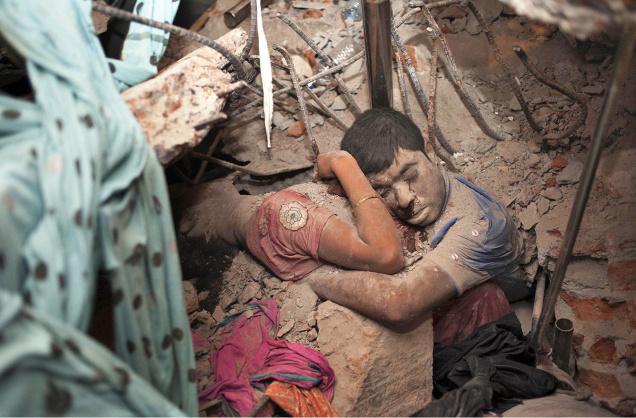
As life ebbed away:  We do not know who they are. This heart-wrenching scene of togetherness as their life snuffed out emerged when rescue workers in Dhaka were clearing the rubble of an eight-storey building that collapsed on April 24. Over 900 lives were lost when Rana Plaza, that housed five garment factories employing nearly 4,000 workers, came down. This picture shot by Bangladesh photographer Taslima Akhter perhaps captures an entire nation’s grief in a single image.

The confessor back with cold feet - Meenakshy Reddy Madhavan


The picture of a seven year old girl, hiding a small notebook when she goes to her class room, just to jot down whatever comes to her mind was like stating the obvious. No other vocation would interest her but writing. Besides, by bequeathing a strong legacy of writing, Meenakshi Reddy Madhavan could not be anything else but a woman of letters.

But surprisingly whenever she wrote she did not hesitate to take a detour from her parents’ style. Unlike her father, the veteran writer, N S Madhavan who loved to fathom the depths of literary fiction and mother Sheela Reddy who always delved into non-literary fiction, Meenakshy loved to ferret out the possibilities of commercial fiction. Ask her why, she says “I realised that no writer talks about a woman like me, a metro and urbane woman whose heart is global but has not lost the link with the tradition. I wanted to explore the pull between these two extremes,” she says. And because of that, there are no clashes as the family has three different genres of writing, she adds with a mischievous smile.

With her third book Cold Feet hitting the markets, Meenakshi was all excited and was in Kochi as part of its promotional tour conducted by Penguin books. The book is all about the lives of five women who live in the metropolis - Mumbai and an account of their daily lives. But primarily it takes the reader on a roller coaster ride of emotions. “I have also talked about a character who is a lesbian,” she says.

The author appeared extremely happy when I told her that I came to know about the promotional event of her book from her blog Compulsive Confessions.

“I should update it more often,” she says with a grin.

Incidentally, her father N S Madhavan who carved a niche in the perceptions of the Malayali readers with his renowned work Lanthan Batheriyile Luthiniyakal, translated as Litanies of the Dutch Battery, was born and brought up in Kochi. Meenakshi says that she is all excited to be here for her father always said it has one of the prettiest bookstores. “It’s right on the sea front with a huge glass window and you can watch the ships sailing through,” she says. I have been to Kochi several times and I love Fort Kochi the most, she adds.

With more than twenty lakh visitors for her blog, she says that she never expected such a huge response and is happy that she could maintain it for the past ten years. “I started the blog with a pseudonym eM as I was a bit bothered about how people would react to the kind of stuff I was going to write. But in no time, the readers identified and I had to come out of the cocoon. But I am so happy that I could maintain it for such a long period,” she says.

About her parents' reaction to her blog, she says, “They were ‘super supportive’. They like my writing.  Hey, I am their daughter, they will definitely not discourage me!” she says.

Asked why is she often referred as the Bridget Jones of India, she says “Honestly, I have no idea. Since you are the one who put this question, I have to seriously think about it.”

Most of her stories were centered in the two metropolitan cities - Mumbai and Delhi. As the author lives shuttling between these two cities, she says that most of her writing contains the pulse of them. “Both cities have different feelings. When you land in the Delhi airport, the waves of tension starts hitting you, unlike Mumbai. When Mumbai is crowded, Delhi gives you privacy. But you just can’t take auto in the middle of the night relaxingly in Delhi as you do in Mumbai. You know the kind of stories we are getting now-a-days from Delhi,” she says. She also cautions to stay safe when I said that I usually leave office very late.

Apart from writing Meenakshi is the editor of Brown Paper Bag.