Friday, June 21, 2013

Blogger and Writer Braja Sorensen

originally published here : Where Nothing is a Taboo


In 1993, Braja Sorensen, a native of Australia, came to India. What prompted her to do so was her deep reading of the Bhagawad Gita. Braja was attracted by the philosophical, spiritual and cultural aspects of “exotic” India.

“I was living here for so many years and I wanted to say something about this country as seen by a person who lived here, and not be someone who visited and thought they understood something, and blurted out all sorts of pseudo-wisdom,” says Braja.

She has toured almost all of North India. She lived in Jaipur in the late 1990s and has also spent time in Delhi, Vrindavan, Agra, Mussoorie, Dehradun and Mumbai so far.
“But my favourite place is West Bengal. I have spent 12 years there,” she says.

And all these years she was unknowingly accumulating the ingredients needed to write a book on India. Thus was born her debut book, Lost and Found in India, published by Hay House India.

The book lays bare the daily lives of the people. As author and playwright Farrukh Dhondy says, “The book does not analyse India, it suffers and enjoys it. It is breezy, light and descriptive, with funny meditations by a voluntary citizen of India.”

It was her daily posts in her blog that eventually got compiled into the book. “I started blogging in 2008,” says Braja. “As I had been living in India for some years and also wanted to write a book, I thought a blog would give me an impetus to write daily. Besides, it was a daily push to write, knowing I had to post something. Obviously, it was going to be about India. I was tired of all the books written by westerners about India.”

Ask Braja about her favourite writers, she says, “I love William Dalrymple’s work. It is so understanding of all aspects of India. And he has inspired me a lot.” Braja feels that one has to love something ardently to write about it authentically.

“You have to love India, to be able to write about it properly. Many think they love it, so they come and live here, and then leave a couple of years later with their romantic ideals shattered by the reality that is India. And that is the thing about India: it is so real. Too real for most.”
In the book, Braja has also written about the recent rape cases which have traumatised the nation. “It happens everywhere in the world, though. The thing about India is that its heart is an open, realistic, and honest one: it does not hide anything. 

Death isn’t a taboo subject like it is in the West. In India, nothing is taboo. India shows its face no matter what, and I think the publicity and the public reaction to the recent rape incidents is just another facet of this honesty and openness, a fresh approach that the West just does not do. So, I don’t think it is necessarily worse here than anywhere else. It is just that India is not embarrassed to put it out there. The same is the case about the poverty and untidiness. Everything is public.”

Monday, May 27, 2013

Jesuit theologian Fr. Samuel Rayan

by Shalet Jimmy
published in The New Indian Express
May 2013
Photo Courtesy : P K Jeevan Jose

A spiritual discourse - Fr. Samuel Rayan

Fr Samuel Rayan was gazing intensely at a book that bore the image of Sree Narayana Guru. After a while he says “Kumaranasan was a dedicated disciple of Sree Narayana Guru and I am an ardent admirer of Asan and his poems. With that, he began reciting his favourite poem from Asan’s ‘Veenapoovu’ ‘Ha! pushpame, adhikathungapadathilethra  Shobhichirunnithoru ranjikanakkye nee Sree bhuvilasthira -- innu ninte yabhuthiyengu, punarengu kidappithorthal and he went on reciting the full 40 slokas of the poem.

Fr Samuel Rayan, fondly called as ‘Rayanachan’ is a Jesuit theologian who has written more than 300 articles. He was at Kochi a few days ago to release his book ‘’ Naleyilekkoru Neelkazhcha’, a collection of his articles organised by OLAM. Though his memory was sharp while narrating his child hood days, it played hide and seek when asked about the contemporary times. After giving much stress to his memory, he says. “It is about future I have talked about in most of these articles in the book.”

‘Fr Samuel Rayan’ was a name which reverberated among the Christian radical humanists during 1960’s and 70’s. His articles in Christian theology were often discussed in national seminars organised to compile opinions on what changes should be brought into the church in the wake of second Vatican council. When the voice of liberation theology started spreading its wings to other continents from its birth place, Latin America, Fr Rayan’s  voice was the strongest from India. As the definition goes,  Liberation theology, an interpretation of Christian faith through poors suffering, their struggle and hope, and a critique of society and the Catholic faith and Christianity through the eyes of the poor, Fr Rayan gave a human Indian face to liberation theology in the country.

Fr Rayan’s apathy towards the rigidities of Catholic church was evident in his writings. He vehemently protested against the hollowness of rituals. He wrote in his book “Rituals should always stand for humanity. Jesus always indulged in discussions and arguments concerning the rituals offered in the Church. He discussed about Sabbat, sacrifice. But every time it was his intention to break the myth and redefine it. For instance, observing Sabbat should be for the goodness of humanity and not to put shackles on them. It is not the sacrifice, offering or rituals that ‘lord’ prefers but compassion and justice.”

In another section of his book, he narrates a story told by Masao Takenaka, a Japanese Theologian. In Seoul, one of the biggest garment factory owner sacked four women for they urged to improve the working conditions and also asked not to make going to church compulsory. The garment factory owner was one of the elder in the church. The factory has appointed a chaplain to counsel the workers.

 It blatantly denied freedom of religion and advised complete surrendering and patience. The four girls raised their voice against it and submitted a memorandum with the church and the latter did not even bother to inquire the veracity of things. They were keen on listening to Billy Graham, an American Christian evangelist.

Fr Rayan asks in his book, in such a situation who will salvage the poor? If their rights were not listened to, who will pay heed to the cries of poor people, asks he.
He says, “Rice is for sharing, bread must be broken and given. Every bowl, every belly shall have its fill, to leave a single bowl unfilled is to rob history of its meaning; to grab many a bowl for myself is to empty history of God.”

Thursday, May 9, 2013

published in The Hindu

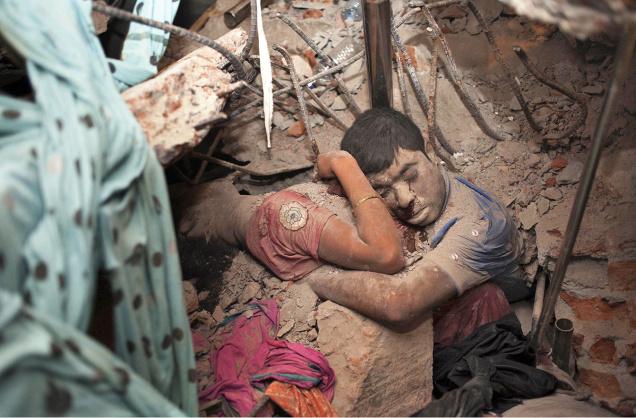
As life ebbed away:  We do not know who they are. This heart-wrenching scene of togetherness as their life snuffed out emerged when rescue workers in Dhaka were clearing the rubble of an eight-storey building that collapsed on April 24. Over 900 lives were lost when Rana Plaza, that housed five garment factories employing nearly 4,000 workers, came down. This picture shot by Bangladesh photographer Taslima Akhter perhaps captures an entire nation’s grief in a single image.

The confessor back with cold feet - Meenakshy Reddy Madhavan


The picture of a seven year old girl, hiding a small notebook when she goes to her class room, just to jot down whatever comes to her mind was like stating the obvious. No other vocation would interest her but writing. Besides, by bequeathing a strong legacy of writing, Meenakshi Reddy Madhavan could not be anything else but a woman of letters.

But surprisingly whenever she wrote she did not hesitate to take a detour from her parents’ style. Unlike her father, the veteran writer, N S Madhavan who loved to fathom the depths of literary fiction and mother Sheela Reddy who always delved into non-literary fiction, Meenakshy loved to ferret out the possibilities of commercial fiction. Ask her why, she says “I realised that no writer talks about a woman like me, a metro and urbane woman whose heart is global but has not lost the link with the tradition. I wanted to explore the pull between these two extremes,” she says. And because of that, there are no clashes as the family has three different genres of writing, she adds with a mischievous smile.

With her third book Cold Feet hitting the markets, Meenakshi was all excited and was in Kochi as part of its promotional tour conducted by Penguin books. The book is all about the lives of five women who live in the metropolis - Mumbai and an account of their daily lives. But primarily it takes the reader on a roller coaster ride of emotions. “I have also talked about a character who is a lesbian,” she says.

The author appeared extremely happy when I told her that I came to know about the promotional event of her book from her blog Compulsive Confessions.

“I should update it more often,” she says with a grin.

Incidentally, her father N S Madhavan who carved a niche in the perceptions of the Malayali readers with his renowned work Lanthan Batheriyile Luthiniyakal, translated as Litanies of the Dutch Battery, was born and brought up in Kochi. Meenakshi says that she is all excited to be here for her father always said it has one of the prettiest bookstores. “It’s right on the sea front with a huge glass window and you can watch the ships sailing through,” she says. I have been to Kochi several times and I love Fort Kochi the most, she adds.

With more than twenty lakh visitors for her blog, she says that she never expected such a huge response and is happy that she could maintain it for the past ten years. “I started the blog with a pseudonym eM as I was a bit bothered about how people would react to the kind of stuff I was going to write. But in no time, the readers identified and I had to come out of the cocoon. But I am so happy that I could maintain it for such a long period,” she says.

About her parents' reaction to her blog, she says, “They were ‘super supportive’. They like my writing.  Hey, I am their daughter, they will definitely not discourage me!” she says.

Asked why is she often referred as the Bridget Jones of India, she says “Honestly, I have no idea. Since you are the one who put this question, I have to seriously think about it.”

Most of her stories were centered in the two metropolitan cities - Mumbai and Delhi. As the author lives shuttling between these two cities, she says that most of her writing contains the pulse of them. “Both cities have different feelings. When you land in the Delhi airport, the waves of tension starts hitting you, unlike Mumbai. When Mumbai is crowded, Delhi gives you privacy. But you just can’t take auto in the middle of the night relaxingly in Delhi as you do in Mumbai. You know the kind of stories we are getting now-a-days from Delhi,” she says. She also cautions to stay safe when I said that I usually leave office very late.

Apart from writing Meenakshi is the editor of Brown Paper Bag.

by Shalet Jimmy
published in The New Indian Express
April 2013

There was a time when Sreelatha used to begin and end her days with versification. The scribblings went on till she had a collection of poems. It was then that she decided to use it as a thread for writing a fiction. Thus was born her debut book,’An Eternal Romantic’.
Set in three places, Kolkata, Kerala and London, the book delves deep into the undulating emotion ‘love’. The story revolves around the ebbs and flows of the protagonist Indira’s life. She becomes a schizophrenic due to her first heart break. The story speaks about her delusional state of mind and its thoughts. But the woman dares to fall in love again. “The language is poetic. Since I have centred my story entirely on my poems, you can read both poem and prose through this work,” she says.
Ask her one of her favourite lines,
she recites
“...tell me, my love
when the grey hair shines
and the weak spine groans
all the beauty of the outside
has faded, tattered and torn
till the day I die
will you keep the romance alive ?”
Though there are autobiographical elements in her work, she says that the characters are purely fictitious. “It abound with my experiences. The protagonist is a doctor and poet like me. I have included my experiences, observations and inherent knowledge. But the characters are born out of my imagination,” she says. Sreelatha says that her debut work is absolutely different from the second book which is progressing. “ The second book is a usual prose but ‘in an eternal romantic, poetry dictates the prose,” she says with a smile.
Dr Sreelatha Chakravarthy’s creative expression was confined to a single poem she wrote during her college days. Much to her discontent, her passion had to be shoved off to the back burner as her later course of life also did not give her suffice time to think of her passion. She became a busy medical practitioner in Mumbai. But the much-anticipated break came when she had to leave her job in Mumbai and accompany her husband to Ghana, Africa.” The break was kind of a boon. In Ghana too,I was attending patients, but the schedule was not as hectic as in Mumbai. With sufficient time, I plunged into my passion, writing,” she says.
Now, Sreelatha has become a full-fledged writer. She lives in Thripunithura with her husband Krishanu Chakravarthy and children Kshitij Chakravarthy and Trishna Chakravarthy.

Friday, April 19, 2013

befitting memorial to Chavittunatakam exponent


He has been sweating profusely under the scorching sun for the past three months in Gothuruthu to see his dream come true. Anto George, an artist from Thrissur is busy sculpting the statue of ‘Chinnathampi Annavi, the proponent of Chavittunatakam in Kerala.

 He has taken up a huge responsibility as it is for the first time that a face is being given to the legend. “It can be regarded as a historical monument. A 11-foot-tall statue of an exponent of Chavittunatakam is being built for the first time. My responsibility is to give him a face,” he says. It was his association with the organisers of Kochi-Muziris Biennale Foundation that gave him the golden opportunity to pursue his dream.

 Chinnathampi Annavi is being depicted in his glittering robes holding a cross with a curve and ivy spiraling around it. The statue stands on a pedestal.

“It is based on the medieval Christian myth which says that the zeal of Chinnathampi Annavi was so intense that the cross started embracing him while he was performing the art. I am designing the statue as if the cross were to embrace him. The climbing ivy suggests the entanglement of good and evil,” Anto says. Regarding the face of Chinnathampi Annavi, he says that the statue will bear the face of Charlemagne, the Roman Emperor whose story, the proponent propagated.

 “Historically speaking I did not have enough materials to support me in this direction. It is still a matter of dispute whether he belonged to Kerala or Tamil Nadu. Some are of the opinion that he is a Portuguese who came here and became a hermit and later took up the proselytising activities through a newly created art form ‘Chavittunatakam’. Apart from that as the legend is always associated with ‘Karalmanscharitham’ (story of Charlemagne), I decided to give him his face,” he says.

 Anto is being assisted by Sunil Kumar, Rajeev Basheer and Shibi. “My attempt is to make a contemporary statue, a  sharp deviation from the conventional,” he says.

  Chavittunatakam experienced a lull for a prolonged period. Of late, it is slowly treading the path of revival. With the country’s first Biennale, the cosmopolitan character of Kochi is also resurrecting. “ At this juncture, it would be incomplete if the name of Chinnathampi Annavi is omitted,” says the artist. Anto hopes to complete the statue before monsoon. “The work is moving at a slow pace. We could have presented it before the Biennale ended but  we want it to be as perfect as possible,” he says.

published in The New Indian Express

Picturing vintage architecture


It was a bright afternoon. Sitting alongside a street at Mattanchery, 10-year-old Achuthan was immersed in painting one of his favourite pictures. Soon the crowd swelled. Undaunted by the overwhelming presence of people around him, he completed his picture. It was then he realised that his painting session had created a minor traffic block. Ask if he was aghast by the incident, he says mischievously “I was just concentrating on my painting. I did not realise until my father told me about it.” 

Unlike other young artists of his age, Achuthan Shenoy loves to paint old buildings in monochromatic sepia. It was a skill that he imbibed from his father. He has also taken the huge responsibility of imprinting the heritage through his painting, like his father. “The age-old buildings are mercilessly demolished. We can learn a lot about our past through these buildings. Hence my attempt is to absorb our heritage on a canvas,” says Achuthan.

He explains that most of the artists paint with the combination of many colours to create a sepia tone. But that cannot be called monochromatic sepia but just sepia. “My father creates the sepia tone with just one colour and hence the name. I too follow that.”

The young artist was ardently following his passion for the past one year.  Achuthan assisted his father in 15 sites before attempting himself in this forte. “Since I am small, my father paints the outer sketch and I give light and shade to it,” he says.

So far, Achuthan has drawn about 15 paintings of old buildings of Mattanchery and Fort Kochi. Though he was giving colours to age-old buildings which can of course be considered as  monuments, he is not a bit scared that it would go wrong. “I know the techniques to rectify the mistakes,” he says.

The young artist says that he also paints every angles of a building. “It will help a person who is new to the city identify the building from any angle,” he says. Besides painting old buildings, he would also like to draw sky, his another favourite subject. Among his 15 pictures, his all time favourite is the 300 year old Portuguese building which is now converted into a home stay.

Ask him why he wanted to become a painter he says, “I want to be famous.”  The dream to become a painter kindled in him, once Achuthan saw his father being interviewed. “If I become famous I will be interviewed like my father,” he says. But Achutan did not have to wait too long, as he was interviewed by BBC crew who reached Fort Kochi to document Kochi - Muziris Biennale. The documentary will have shots of Achuthan painting in the street.

Though Achuthan is indisputably a painter in the making, he has not participated in any competitions. “I do not want to participate in competitions. I just want to draw without any inhibition,” he says.

Apart from monochromatic painting, his another passion is music. Achutha Shenoy is the son of Dinesh R Shenoy and Asha Shenoy.

published in The New Indian Express

Wednesday, March 27, 2013

A forum for established and budding writers


This is the link of the journal http://issuu.com/lijla/docs/feb2013

Blogs and electronic journals have come to the aid of writers who want to write their heart out and widen their horizons. But what if you get a platform to showcase your writing, alongside renowned writers from all parts of the globe. This is exactly what the writing forum of Sacred Heart College, Thevara, Kochi has come up with. Their online journal, ‘Lakeview International Journal of Literature and Arts’, launched in the first week of February, has contributions by acclaimed writers like K Satchidanandan, Sudip Sen, Haneef Qureshi, and Meena Alexander, apart from the writings of students.

Jose Varghese, Chief Editor, and a faculty with the Department of English, said that the idea to start such a journal came from the blog which the college already has: ‘Heart - Bytes’ (www.heart-bytes.blogspot.in).

“The blog was started a year ago with the intention to develop the writing skills of students,” says Varghese. “There are many students who are serious about writing. We believe that the journal would give an impetus to their skills.”

According to Varghese, though they started the blog little did they know that it would soon gain international participation. However, it was the writing contest on the blog which led to the creation of the online journal. “Our blog has hosted many creative writing contests and, surprisingly, we started getting many international submissions,” he said. “Hence we thought of getting the contributions of well-known writers.”

One of the salient highlights of the journal is that the student writers are getting an good opportunity to interact with the prominent writers directly “which is a positive sign,” said Varghese.

The journal features the 12 best works by students. “So far, the works have been assessed by the faculty of the English Department,” said Varghese. “But now we are planning to send these works to prominent writers for assessing it. We are hoping to get a positive response. Some of our students are even sending their works for review.”

Student Editor Mariam Henna, whose two works, ‘Caged Dreams’ and ‘True Abode’, were published in the journal said that it helped garner reviews from authors. “The support given by writers Prathap Kammath and Alan Summers, a Haiku writer, were of immense help,” she said. The writing forum of Sacred Heart’s College, Thevara is also planning to start an online course in creative writing.

Saturday, March 16, 2013

Reliving the saga of Ahalya Devi - Usha Nangiar

For Usha Nangiar, controversies always take a back seat when it comes to art. The front line exponent of Nangiar Koothu has performed in the Kochi- Muziris biennale twice and with other two performances remaining, Usha says that she has a memorable experience performing in the biennale. Primarily for the reason that her performance could attract a lot of people irrespective of the technical intricacies involved in the particular art form and secondly, she performed for the first time, the known but less explored character of Ramayana, ‘Ahalya Devi’.

Speaking about the controversies surrounding the biennale, she says, “I was aware of it but my thoughts hardly linger on it. And I think this is the first time a biennale has ever incorporated traditional art forms under its ambit which should be appreciated.”


For biennale, she first performed in Mathilakam and later at Changampuzha park where she says that a packed audience saw her performance.“In Mathilakam, people are not much aware of Nangiarkoothu, but yet they enjoyed throughout the performance. It might be because of the myth associated with the place. There is a reference that Ilankovadikal wrote Chilappathikaram there. But in Changampuzha park, I felt altogether a different experience  while performing ‘Ahalyamokshma Nangiarkoothu’. It is much more personal. The tempo of my emotions at that point of time was at its zenith. I felt as though lady-luck was constantly smiling at me on that day,” says a jubilant Usha.

She says that she is greatly thankful for whoever who have actually suggested this particular theme.  Though there were initial apprehensions about it, later it was proved that all anxieties were for naught.
“It opened an arena which I have never explored before. Since I did not have sufficient reference material to know more about the character, I relied completely on Ramayana.

Immersed in deep thought, Usha Nangiar says that Ahalya, the wife of celibate sage Gauthama was living the life of an obedient wife until the amorous eyes of Indra fell on her.Her life turns topsy- turvy when Indra deceives her by approaching her in the guise of her husband. Discovering the truth, sage Gauthama not only curse her but also turns her into a stone. “I want to portray the emotions and angst of a woman who is trapped in a stone,” she says.

Usha says that though inside a stone, Ahalya is aware of the world around her. Seasons change, hunger, thirst, scorching sun, parching cold engulfs her. But she could not do anything to help herself. Her travails slowly become a silent but strong prayer of utter faith.“Her redeemer Rama feels the divinity of the place when he reaches where Ahalya lies as a stone. When he knows the truth, the great lord bows before her and says she is redeemed. Till that portion, she is addressed as Ahalya but then as ‘Ahalya Devi’ which says that she commands respect,” says Usha. 


She points out that throughout the whole performance, there are four special points which presents the mental-scape of Ahalya. I believe that I could portray the mental angst of Ahalya Devi and above all, it was a day when everything fell into places,” she says.

Usha Nangiar says that the character of Ahalya Devi assumes significance as hers is a life that has overcome all the hurdles with her sheer perseverance and sacrifice.“Now-a-days, we believe in extremes. If we can’t take anymore, we cull out that portion from our life mercilessly or else we suffer tremendously. But we tend to forget that there lies a midway. Hence the life of Ahalya Devi is of paramount significance in this scenario,” she says with a satisfied smile.


Friday, March 15, 2013

OFF record with Kumar Sahani, world acclaimed film maker

 Till this day, I was just  uploading those articles which were published in the New Indian Express where I work. And I think that a personal touch would be lacking if I merely upload it. Hence I thought of writing those special experiences I had while writing those articles. I would like to start with Kumar Sahani, whom I interviewed at the start of my career. If you haven't read my article on him, you can read it herehttp://ajournotalks.blogspot.in/2011/11/interview-with-kumar-sahani-renowned.html


Of course, I have heard about him - World famous film maker,  friend of legend late M F Hussain. I met him when I started off my journalism career. He came to Kochi ( where I live ) to inaugurate a seminar in a university. For a budding journalist like me, it was an opportunity which seldom knocked - interviewing the renowned film maker. So when my boss mentioned his name,  I jumped to have a one to one conversation with him.

I still remember, it was noon when the organisors came to fetch us, reporters to interview him. Apart from me, there were other two, one from a regional news paper and other from another English newspaper.

Clad in white Kurta and off white pants, the great film maker showed no starry tantrums. He was a simple and an elegant man. He inquired the names of our organisations and he was to quick to recognize when I said I was from Indian Express which put me at ease.

To interview somebody you should have a back ground knowledge.Though I did my home work, it was not too easy. His films were not easily accessible. I also googled for more information but his movies were beyond my comprehension.

As I was an electronic journalism student, I had seen Ritwik Ghatak's movie ' Meghataktara' who was Shahani's contemporary. That knowledge came handy. Because of it, I could feel the pulse of that era.

With scant information and full of respect for such a legendary figure, I decided I would rather keep myself away from delving deep into his work but ask about his personal experiences about life. That worked. We had a wonderful conversation and I could feel the rapport he felt for me than my other companions. It was confirmed when he said to some of the organisors  of the event that he was quite impressed with the girl who came from Indian Express.

But I still doubt whether I could write everything I felt while I was interviewing him. I hope you might have read the blog post. Hope you would give me ample suggestions about my writing.

On a mission to preserve integrity of RTI Act- Shailesh Gandhi


When Shailesh Gandhi, the only Right to Information (RTI) activist to have served as the Central Information Commissioner, assumed office, it definitely looked like a long row to hoe. But in no time he made a headway with his RTI activism.

Though he has retired from service, after four years with the Central Information Commission, his voice is as intense as before. Gandhi was here to inaugurate a seminar titled ‘Challenges of RTI’ held on Monday.Gandhi feels that many political and judicial decisions are diluting the purpose of the RTI.

The Supreme Court had judged that the Information Commissions must function as a two-person bench, with one judicial member, with a strong legal background, required to be part of the bench. Gandhi feels that the judgment made by the apex court is incorrect, as the requirement puts the hearings on hold for many days. “Out of all the RTI applications that we receive, less than two per cent need legal explanations. Therefore, a judicial representative is not a necessity,” he said. Gandhi said that he had filed a review petition against the judgment made by Justice Swatanter Kumar.

“Lawyer Prashant Bhooshan appeared for me in the apex court. Any move which could kill the purpose of the RTI should not be encouraged.”  Gandhi told Express that he has launched a crusade against the forces that try to dilute the RTI. “The Supreme Court and the High Courts are issuing stays on many of the orders made by the Information Commission without even considering the details. This trend should be discouraged. I appreciate every opportunity to spread awareness on RTI.”

An IITian, Gandhi’s focus shifted to the RTI when he was in his fifties. “The political scenario was much better then. But it was changing for the worse and I wanted to do something substantial for the society. I felt that the RTI is a remedy,” he said. Gandhi thinks that the RTI faces challenges from three domains - the government, state information commissions and judiciary. “Information is power. It can change the equations of power. So these challenges should be dealt with. I am ready to fight for the sanctity of the act,” Gandhi said.
When Paramita Satpathy explains her poem ‘A sari’, it is indeed the resonance of the contemporary traumatic world. The poem says, “Though we keep on talking about a woman’s morality, her respectability is ruthlessly quelled in this unjust world. The five- yard sari is considered a symbol of respectability. But when I felt it more of a suffocation, I shred it into pieces. I gave the torn pieces to a rag picker, a rape victim, a dowry harassment victim who is struggling for her life in a hospital and a slumpy bar maid.” The renowned Odiya poet, author and social activist was in the city to inaugurate the G Smaraka Jnanapeeda Puraskara Prabhashana Parambara, held at Maharaja’s College.

The poet feels that the situation is such that women could no longer tolerate the hard cruelty meted out to them. “That’s why India witnessed such a huge commotion and protest of massive scale post the Delhi rape incident,” she says. Satpathy says that though the world has progressed, the erosion of humanitarian values has always put a spoke in our country’s wheel.

When Satpathy began her conversation, there was no airs of a high level bureaucrat. Besides being an influential voice in the Odiya literary fraternity, she is currently working in Bhubaneswar as the Commissioner of Income Tax. Though she has not encountered any challenging experience in her profession, she still feels that unlike her male counterparts, the path for women is hardly ever rosy whatever be the profession.

“There are times when you really have to push the envelope to get things done.” But Satpathy adds that as a writer she had to confront many hurdles. “Criticism was showered upon me when I wrote about the relation existed between Draupathy and Sree Krishna. Every relationship cannot be defined. But I took the criticism in my stride,” she says.

Expressing elation over the celebrity status given to writers in Kerala, Satpathy says that the writers of Odisha are not such a privileged lot. “Unlike Kerala, the writers of my state are not in an influential position in society. Besides, writing is also not as much rewarding as it is here. But we are taking painstaking efforts to raise an intense voice,” says she.

Till date, to her credit, there are seven collections of short stories and one novel in Odiya. ‘Door Ke Pahad’, a collection in Hindi and ‘Intimate Pretence’, a collection in English are widely discussed and brought her much acclaim. Most of her stories had addressed the recurring problems of the middle class of Odisha. The poet is known for her sensitive portrayal of the plights of modern woman with utmost perfection. Paramita Satpathy has received the Odisha Sahitya Academy Award and has re-presented Odiya literature at Bejing International Book Fair as a member of the Sahitya Akademi delegation in 2010.

me with the writer


Tuesday, January 8, 2013

Art as a vehicle of change

 ( Courtesy : P K Jeevan Jose)

“Every new venture in the world has always got a lot of flak before finding success. I believe the Kochi Muziris biennale also had to bear the brunt of that initial hubbub,” said Hoor al Qasimi, director of the Sharjah Biennial and President of Sharjah Art Foundation. She was in Fort Kochi recently to attend a talk series organised as part of the Kochi-Muziris Biennale.

She says that though Kochi-Muziris Biennale is steeped in controversies, she was pleasantly surprised to see that the event could project its actual purpose.     “The elementary objective of the biennale is to portray the local culture of the city or the place where it is being conducted. This biennale could achieve it successfully,” she says. She adds that the biennale could very well exhort the old charm of this city.

Hoor al Qasimi is a practicing artist who took her Bachelor of Fine Arts (BFA) degree from Slade School of Fine Art, London, Diploma in Painting from the Royal Academy of Arts, MA in Curating Contemporary Art from the Royal College of Art, London.

The curator recollects that she too faced stiff resistance when she wanted to bring forth a change in the character of the Sharjah biennale when she assumed charge as director of the event. “I literally grew up with biennale. After learning much about what is going on in other parts of the world in the art fraternity, I realised that the Sharjah biennial is static. It has not even took a step forward from where it began. Hence I decided to bring forth a substantial change in the character of the event. That’s when the opposition crept in,” she says.

Hoor al Qasimi says that in earlier times biennale was all about representing art from all over the world. “Artists from different countries would come and represent their work of art. A sense of unity was completely absent. Unlike other biennales that happen in different parts of the world Sharjah biennale lacked a common theme. To make it more worse, there were many embassies which sent the works of their ambassadors’ wives. So the scenario as a whole was seeking a change for the better. That’s how the call for improvement came about. But though the change is inevitable, I had to face a lot of disapproval. But that is the only way it can work,” she says. She says that unlike Kerala, Sharjah biennale is not associated with tourism so far. “I do not want people to frequent the biennale just because they came to the country as tourists. I want people to come for the biennale first which in turn help will tourism," Qasimi says.

( me with Hoor al Qasimi)


published in The New Indian Express